
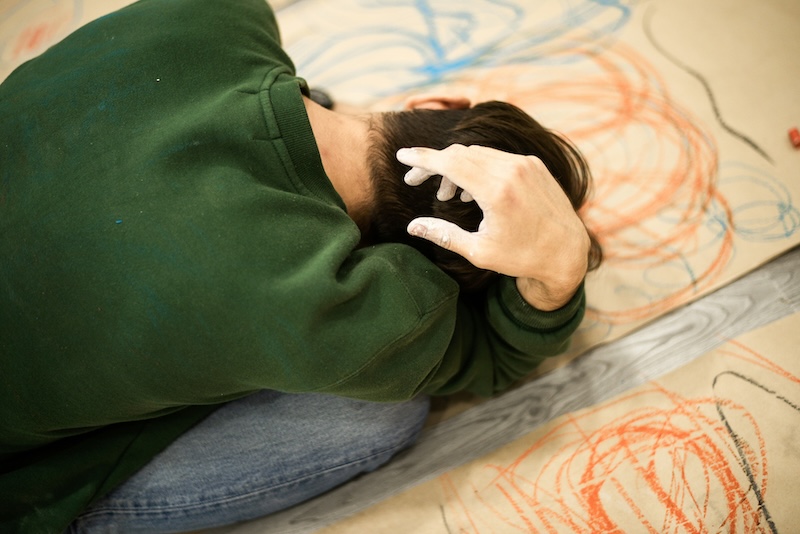
My approach to art therapy is informed by Lacanian psychoanalysis. This might seem an odd pairing at first, as Lacan famously insisted on the importance of speech and language, while art therapy sessions have been known to occur in total silence. The type of art therapy I articulate here is certainly unusual within the field. My approach is particular to me, my patients, and my clinical interests.
I do not see my art therapy practice as separate from my psychoanalytic practice—patients do not come to see me for either art therapy or talk therapy. In all of my sessions, I have a variety of art materials on hand during sessions that my patients are welcome to use. I tend not to directly invite patients to make art, but some do of their own volition. Other patients
make art outside of our sessions and bring it into the consulting room. Some show me images of other artists’ work or describe their encounters with artwork, performance, or music in our sessions. In other treatments, visual art may never enter the work. If, when, and the extent to which patients use art in our work together is up to the patient’s desire.
In working with the art presented to me, I consider the ideas of Lacanian-Winnicottian art therapist Mardy Ireland, “the phenomenology or interpretation of images per se in the drawings is less important than the discourse they facilitate” (2003, pp. 116). When a patient shows me an image, I ask them to speak about it. This could take the form of a direct invitation to speak (“What do you think?”) or a more subtle encouragement through descriptive statements (“The woman is wearing glasses”). My clinical practice is concerned with what is unsayable, and my process with patients is to bring something of the unsayable into speech. In this work, artmaking does not serve as a substitute for speech but as a way of beginning to speak.